DiveSigns

Showing posts with label deco. Show all posts

Friday, 30 October 2015

Dive Report: Karwella

About the wreck

The Hellespont is a paddle steamer that was converted to be a minesweeper during WW1.

Dive Report

Descending down the shot I was starting to prepare my GoPro as I wanted to get some video of the descent, but looking at the screen I could see that I still had video on the memory card - curses! I know I pulled off the video last night, so time to do an SD card format, all whilst descending at about 15m/min, clearing my ears, equalizing my mask! By the time I had reached 30m I had the card cleared and the video recording started, so I started my continual recording of the dive now including the last part of the descent. (I had hoped to get more of the descent so that you can see the wreck appearing in the blue).

The wreck appears below us

Getting settled and achieving neutral buoyancy at the stern, Rob was already waiting for me and settled. Dropping all the way down to the seabed we saw the massive triple rudder and the propellers.

Triple rudders
At first I shot some video looking from behind the propellers while Rob waited a few meters back and above.

From the propellers

Then I passed the camera to Rob who then recorded me at the propellers and ascending back up to the stern where we then entered the main deck area of the ship.

Me heading off to inspect the propellers
It was wide open, probably a communal area. Along the length there were metal supports for the deck above. Approximately 1/3rd and 2/3rds of the way along in this compartment there were hatches that led into the compartments below.

Main deck

A quick look back, I gestured to Rob about going in, he's OK with it so I descend head-first down through the hatch. It was just a simple square room, Rob and I swam a lap around the room and then ascended back on the main deck.

Back on the main deck, I took the GoPro back off Rob, did a gas pressure check. This is a two part process: firstly we check our bottom gauges - this will tell us depth and time. As a diver we know the rate we consume gas so it is a simple case of rate x time x depth which will then give us the amount of gas consumed. Then we check our pressure gauge which tells us the remaining pressure - the two should be close, they are which means the dive is going according to our plans.

Current depth: 33.7m, current time: 12 minutes, max depth 42.6m, temperature: 24 degrees!
We are 12 minutes into our dive plan and we are mid-ship now, as we swim through a compartment the regulator on my side-slung decompression cylinder gets caught on a lip so I had to take a moment to get tidied up. We continue on where we come to the stairwell. Here there are two sets of stairs - one leading up, one leading down.

Heading to the stairs

Annoyingly there was a pair of divers kneeling down at the top of the stairs, so it was a faff to move past them - they are wearing just a single cylinder, whereas I have three! I ended up having to rise to the roof of the room to get above them and then follow the roof of the stairs down as opposed to a nice glide down the stairs. Oh well.

The room is a another simple square room. Rob does a lap and swims under the stairs before we ascend back up.

Rob swimming up the stairs

Leaving the stairwell, we continue to head forward. The next compartment has some degradation because the roof has collapsed in, a quick check of the computer: dive time is now 18 minutes. It feels like it has been far longer! I flash Rob (with my light!) and check he's OK.

Leaving this compartment we head towards the bow.

Arriving on the bow
We are hovering above the anchor lifting mechanisms. Looking back we can see a large structure: there are two more decks above the deck that we swam along, so we head back up over the structure.


Heading towards the bridge


Arriving on the next deck, we look in the windows and see an open structure, so decide to ascend to the next deck. There are several groups of recreational (single-tank) divers on this top deck (at about 30m) so we swim around them where we can and crossover to the starboard side. There are streams of bubbles coming up through holes and vents underneath us which makes the wreck look like it is alive and breathing.

Rob and I have a quick chat about what way to go, and to check pressure gauges and bottom time. We are approaching our planned bottom-time and (based on some quick sums) my pressure gauge is telling me that I don't have much longer left until I have to start the ascent (for completeness: this is not my guage reading almost zero, far from it! Rob and I have agreed a volume of gas / pressure the previous night that we are reserving for emergencies, such as entrapment, team separation etc, we have to start our ascent before we reach this pressure). Rob then takes the GoPro off me to record me for a little while.

Yours truly!
I swim off the wreck a little, this gives me a view of the whole wreck (and gets me out of the way of the other divers).  I'm heading aft and around the back of the main structure on the top deck. Roger is on the very top deck with his team above us.

Swimming around on the main deck
I've swum around to the starboard side again on this penultimate deck and I'm looking at the entrance to the picturesque stairwell. I ask Rob if he wants to go in to get some more pictures... He gives me the hold / stop sign... He tells me that my breathing regulator on my side slung decompression cylinder is hanging loose and needs tidying. So I quickly fix it prior to entering the wreck.

Teamwork: tidying up
With the regulator tidied away we entered the room. I was a little confused at first - this stairwell seemed so much lighter than the one Rob and I had gone down earlier... That's because this is the stairs on the deck above! I descended the stairs and did a 360 at the bottom. Rob was waiting for me at the bottom, he wanted to record me swimming up the stairs.

Swimming up the stairwell

I left the stairwell through the same door we came in. Before heading off towards the bow, I checked my SPG - I'm only a few minutes away from hitting my reserve pressure, so decided to tell Rob to turn around and lets head back towards the shotline to head home to the boat.

So I headed off in the direction I thought the shotline was in ... we dropped onto the wreck near the stern and we mostly came down the shotline, so surely it should be somewhere around there - it will come visible as I get closer to it .... surely.... won't it?

Anyone seen a shot line around here?
We had a little underwater debate because I couldn't see the shotline and Rob thought we still had to swim to the reef to meet the boat (at the last minute the skipper said he would wait instead - lesson here - any 'plan' changes, confirm with the team don't just assume they heard the skipper).

I was getting flustered, but couldn't see the shotline, so I just ordered a straight ascent - I was expecting to get a shred torn from me because the skipper asked that if making a free ascent EVERYONE launch an DSMB (a floaty marker). At the last second before jumping in I had detached mine because it was getting tangled and not staying stowed. I figured a pissed off skipper and being alive with everyone was worth it. Because of my flustering, I had now consumed the last of the gas before hitting the reserve, so ordered the ascent. I led the way (so that Rob knew I wanted us to get moving). As we ascended Rob unpacked his DSMB and launched it.

By the time we arrived at 21m we switched onto our decompression gas and started watching the minutes tick by ... I like to give the first stop about 5 minutes, whilst I worked out the profile, Lee appeared! He asked why we launched a bag ... he then turned around to point at ... the shot line ... so in 30m+ visibility I failed to find the shotline!

I slapped my forehead to show I admitted the navigation failure, and he double-checked we are definitely OK - yeah we were just got lost :)

Rob is looking after the DSMB.

Rob on deco
Meanwhile I'm trying to take selfies with the other team in the background!

Selfie! The team is about 30-40m away behind me!

Dive Video

I have managed to pull together a short video of our fantastic dive - check it out below! If you like it, let me know! Follow me on Vimeo for more of my videos!

Thursday, 29 October 2015

Dive Report: Um El Faroud

About the wreck


Dive report

Entering the water, the Techwise group became two teams. Alan, Rob and I waited patiently just below the surface, while the Dutchies sorted themselves out. Eventually they descended and my little team headed off. Alan lead us most of the way following the wall of the valley and then pointed me on the right way to the wreck, so I headed off. It wasn't until a few minutes later that I had a fin-tug - I turn around and see Alan! He points me on a new bearing to the wreck, which I follow and we eventually hit the stern.

Arriving at the stern
Settling at the stern, I wait for Rob to arrive with me, turns out apparently I had been swimming uncomfortably quick getting to the wreck - this has happened a few times whenever I have led a dive, I really must try and slow down when I lead.

Settled down and closely re-united, we head off along the starboard side of the ship, swimming along the side of the superstructure the whole way. Along the way there were several entrances into the wreck. I really haven't explored the wreck anywhere near enough, there are whole decks I don't even know about! Continuing forward I swim under the huge davits, possibly 20-25 feet tall that were used for holding and eventually deploying life-rafts. It always 'twangs' with me when I see these on any wreck, because I always have a mental flash back to the scene in Titanic where Rose challenges Mr Andrews (the ship designer) on how few life-rafts there are.

Emergency rescue boat davots
Continuing along this deck, we reached the end of the super-structure and we therefore dropped to the main deck, but on the way I stopped to look at a plaque that has been attached to commemorate the workers that died when there was a massive explosion in one of the main storage tanks. Sadly 9 workers lost their lives.

Plaque commemorating the victims
Rob and I continued forward. In 2006 there were massive storms that hit Malta and the currents also affected the Um El Faroud wreck. The rear is weighed down by the massive engines, however the forward part of the ship is just empty space, as a result the storms split the wreck in two. Currents are now causing the two parts to drift apart. Now they are probably 15m apart from each other.

Swimming the chasm between the two parts of the wreck, Rob and I slowly dropped down to the seabed so that we could swim through the bulkhead that would split two storage areas in the ship. Swimming through a door, I turned around waiting for Rob to follow me through ..... no Rob ....give him a moment, he'll be right behind me .... still no Rob .... give him a bit longer ... nope still no Rob .. where the hell is he? ... I see a glint in the very corner of my left eye ... I look left and I see Rob's shaft .... of his light coming through a hatch on the other-side of the bulkhead. Swinging the GoPro around to be at this doorway instead to record Rob as he comes through.

Rob swimming through the bulkhead

Swimming further forward in the storage cell, we start to enter an area with no light coming through from above, the light is dropping, but we can still clearly see that there is yet another bulkhead ahead of us. Swimming forward, Rob led and we swam through the bulkhead into the next compartment. It is pitch black in here with the exception of a small, 10" hole above us streaming white-blue light in via a pillar of light. The compartment is completely empty, we can see the ribs of the keel but other than that there is little of interest so we exit this compartment.

Between the two bulkheads that we swam through, part of the decking has been removing, so we ascend gradually up to it. Rob finds a ladder to 'climb' which brought us back to the main deck.

Rob climbs the ladder.
Swimming along the deck, we are approaching the bow. There is small one-man passageway that leads into the bow structure, but we ascend up onto the bow-deck.

Swimming up onto the main bow-deck
On the bow-deck now, Rob swims forward to look down a hatch which leads down to the passageway that I just mentioned. It's hard to resist looking down a deep, dark hole.

Despite having the ability to move how we desire in the 3D space that is the sea, we swam up the stairs to the starboard to take us to the absolute top deck of the bow. On this deck is the machinery for raising the gigantic anchors. The chainlinks are made from steel a good three inches thick.

Anchor hoists

Now I decided to capture what I thought would be a 'million-dollar-shot' (like the one in the HMS Hellespont dive), I had Rob hold steady hovering just behind the bow-structure, whilst I swam right out away from the wreck and recorded Rob hovering there above the bow. Watching this shot back, I wish I had gone even further so that you could see the keel go the whole way down to the seabed.

That's another million in money-shots :)
Heading back along the port side of the ship, we swam down the stairs to take us back to the bow-deck. Along the way, Rob finds a large hole into a compartment below the deck. Looking down there is some large machinery, some kind of venting equipment.

We continued our journey back, about to reach the gap between the two sections of the wreck, I took the opportunity to capture some video of Rob in perfect trim as I swam up beside him.

Swimming across the gap, we swam straight for the main superstructure. At the bottom of this structure, there is a door leading in. How inviting! Rob gave me a quick glance, with a gesture of heading inwards, a quick but enthusiastic nod was all I had to do and Rob was off!

Entering the engine room
Heading inside, we have large bore pipes running above, and on either side of us. There is a beautiful blue light pouring in through doors on either side of the deck, as well as pouring in from above us at the far end of the compartment.


Rob drops down a gap in the decking so that he can descend deeper into the engine room. At this point I've now got my work cut out: I've got a light on the back of my left hand, the GoPro in my right, I also need to descend behind Rob which means I will need to 1. equalise my ears by gently blowing whilst pinching my nose so that my ears don't get crushed by the increased water pressure caused by descending, 2. equalise my mask - again the water wants to try and crush it and 3. squirt some air into my wing to try and keep my neutral in the water - all at the same time! Oh and ideally not shake my light around too much because as a team we use the light to communicate - if you see a rapidly moving light, it normally implies a diver in an emergency - I don't want to false alarm Rob!

Rob is waiting, floating above a walkway while I get settled on the same level a quick circle of the lights in a large O is our way of communicating "You OK? Yeah I'm OK too".

On this level, there is a small office in the corner, there is still a walkway going further aft, but we work around this deck.


We are now coming around the starboard side of the compartment, about 5m below us the huge engines are visible, we are floating above them looking around - there are so many corners to investigate but time is limited!


To our right there are more rooms, even some stairs leading up into an area I have never been before. Swimming through a hatch, we arrive underneath the entrance that we came in to the engine room from.


I thought now would be an ideal opportunity for a selfie, with the dark background of the compartment behind me!


At this point, I could see that Rob was tapping his computer quite a lot, he turns around to me and says the computer is broken (imaging breaking a  twig in your hands - that's the guesture). Whoops! Now I ask myself - Chris, so what's our average depth been? (my computer only tells me current depth, so I have to check it every few minutes and do some sums in my head to track average depth). I had been tracking it, but I sanity checked myself, the deck is at about 20-21m, the very bowels of the engine room is 32m, but we were not that far down, so I played it safe by picking an average depth of about 24m. Next question, how long have we been down ... *look at computer* approaching an hour. So with those two pieces of information I can start working out a decompression strategy.

We are now heading back along the port deck, looking out to my right I see a school of barracuda swimming gracefully.


Arriving at the stern, its time to head back to the inlet. Now from memory I thought that if we took a 45 degree angle running off the stern that should bring us nicely to the inlet. On the way we would switch to our 50% oxygen decompression gas, and then follow the wall around to the inlet, ascending slowly as we go, before completing the bulk of our decompression between 9-6m in the safety of the inlet.

That was the plan ....

Things didn't QUITE go to plan.

We took the 45 degree bearing off the stern. I figured 5 or so minutes we would start to see the wall. There is also a divers helmet mounted on a plinth on the way ... After 5 minutes I had NOT seen the plinth nor could I see the wall. I was keeping us 'deep' at about 25m because I wanted to keep an eye on the seabed for clues to home. I was getting twitchy, my reserves were running low and decompression obligation is racking up and I wasn't sure exactly where we were. I turn around and ask Rob where he thinks. He wanted to go further right, but that REALLY doesn't feel right to me, so I keep us on the bearing I was headed on. But I wanted to get us off the weak trimix and onto our decompression gas - doing so means that we will be at least starting our decompression even if we are fannying around trying to find home.

I turn around again I tell Rob we are going to switch. First thing, I had to bring us up to 21m so that we could safely breathe the 50% oxygen mix in our stages ... I got us settled, and I had Rob switch first. Once he was settled, I switched. I did feel my body unwind a little, I was now on a relatively plentiful gas supply now.

Time to continue heading home.... I keep us swimming on our bearing a bit more then I get my first clue, and it wasn't any of the physical clues mentioned earlier: I was a boat going overhead. I know boats go in and out the inlet regularly, now sound does travel very quick under water which makes determining direction virtually impossible (the sound arrives at both ears at virtually the same time) but I was adamant it went straight over, so I re-directed us.

Swimming onwards, I'm getting more and more tense again because I can't see any walls (it turns out I was basically swimming right up the center of the inlet, but because of the 'poor' visibility I couldn't see either side so I didn't know I was coming in the inlet).

We had been swimming at 21m for about 5 minutes now, so it was time for us to move up a bit to 18m. Because of the stress of getting us home, I hadn't worked out a pucker decompression pattern, but what I was doing was giving us 3-5 minutes every 3m, I knew that would result in a massive decompression time, but that would definitely be enough.. Up to 18m in mid-water. Then carrying on.

I got a slightly better feeling now because I could see some kind of rocky seafloor coming up underneath us, I know the inlet ramps down to about 20m so I started getting a feeling like this could be it - in any case, we at least found the coast of Malta again!

Rob asked me about our deco, I asked for his wet notes so I could start writing some info down. My theory was if I give him the key points, he could work out the deco in his head so he would feel comfortable with my proposed deco. So I tried to tell Rob the key points. In my mind they were
  1. Average Depth: 24m
  2. Bottom Time: 65 minutes 
The deco profile I was thinking was based on the 45m diving we had been doing the previous days because I wasn't thinking clearly enough to really work it out
    1. 21m - 5 (already completed)
    2. 18m - 3 (already completed)
    3. 15m - 3
    4. 12m - 3
    5. 9m - 5
    6. 6m - 10

Time to move up now, we also plodded along the seabed until we hit the "ceiling". At about the 13m area, I looked up and could see the surface, although with the current profile I was still 15 minutes away from surfacing.

Almost to the surface now ..

Whilst I looked up and trying to triple check my numbers (to make sure that they were at least on the conservative side) and self-checking (have I got pain in any joints? Am I already bent?) I saw my proof that everything was going to be OK. I saw someone jumping in the water, looking behind them I saw the infamous ladders. I had got us back to the inlet - at this point, I felt my entire body relaxing.

Rob and I got settled against the wal at 6m to get cosy for the 'long' stop of over 10 minutes.


Hitting the surface, it was lovely to feel the sun on our faces again. The dive had been excellent, there was a period of 20 minutes of truly stressful moments, but it was an amazing dive!

Dive Video

Throughout the dive, I had been shooting video on my GoPro Hero camera. I've assembled the video into a piece which you can watch below. If you like the video, let me know with a 'like' (the heart icon!).

Tuesday, 27 October 2015

Dive report: Hellespont

About the wreck

A paddle steamer converted to a minesweeper for WW2. The first mine it found blew out a massive chunk of the bow.

Dive report

Using the Techwise RIB from St Paul's bay it was a 15 minute ride out but with a bit of chop. This time I had managed to get into my wetsuit completely before we departed. At the five minute warning I started to get into my rig. I was kitting up next to Alan, who didn't start getting into his JJCCR until much after but was ready and straddling the tube of the RIB for a sideways entry.
Rob and I back-rolled in, and descended down the shot, just like on the Imperial Eagle it felt like the first few metres were hard to drop through, but after that we accelerated our descent and after nearly 3 mins we arrived onto the bow of the wreck.

At some point during the descent, my DSMB unravelled. So upon arriving at the bottom I had Rob help me do a rapid re-roll and stowed it on my butt d-ring. The clarity that the trimix was giving us meant that we quickly worked together with no communication required other than Rob pointing out the problem.

I then dropped into the forward bow compartment to look around, I found a lobster pot before exiting.
We then proceeded down the starboard side. Oddly enough Rob and I noticed some brief flashes of light, we assumed someone has a strobe.

Looking into the bow

We moved around to the starboard side past what we think would have been the bridge. Underneath this structure is the massive engine. The engine and the structure are still reasonably intact, probably because they are made of iron perhaps?

Looking in to the engine

Moving further aft along the starboard edge, looking left I can see a boiler laying perhaps 50' feet away. There is no debris between the main ship structure and the boiler which says to me that the boiler came apart from the ship at the surface. If the wreck has crumbled as it sank, I would expect a large debris field around it.

A quick look down and I noticed a few holes in the deck, not through damage, these are intended / designed. Looking down I see a ladder running down from the deck into a hold: I can see large black lumps down there. This is a coal bunker.

Coal bunker

Just after (heading to stern) these hatches is the starboard shaft that would drive the massive paddle wheels.

A quick look at the bottom timer: we are at 9 minutes runtime and I'm at a depth of 38.5m. I'm not feeling it though, my head is at the equivalent of just 26m thanks to the 25% helium content in my twinset meaning I'm breathing less nitrogen, which in turn is reducing the impact of nitrogen narcosis. Basically,  this means my mental faculties are completely intact, whereas without the helium my brain power would be equivalent to having a big night on the town! Oh ... and it's 22 degrees at nearly 40m!

Bottom Timer: 38.5m
Heading further aft we see that the deck area which would have masts or other structures with rigging on is a mess ... heavy cables are strewn across the deck. Heading further aft, we come to a wall of fish. There is a tight school of fish running about 0.5 to 1.5m from the sea-bottom, and then looking upwards there sea is just filled with hundreds of fish everywhere. This is paradise!

Beautiful water with fish everywhere
We slowly swim around following the hull of the ship, the wreckage is incredible, but still very intact which allows for a good peer into the various holes. Following the port side of the ship along, we come to the the cavernous opening on the side of the ship where the mine exploded. Unlike the Titanic which could have stayed afloat with some relatively simple design changes, there was no way this could have stayed afloat: the ship have basically been opened from keel to deck. The water would have poured in.

Mine Damage
We met Chris Ryan here who took a few pictures of Rob and I. We had a good look in here, you can see the boilers up close and there is probably room to get in, it would be tight, one man at a time but could be done. I was sorely tempted but thought I'd give it a miss. I ascended up towards the deck so that Rob could get in there and have a look about.


Whilst I was manoeuvring myself, I stumbled across Alan on his JJ and a bottle of red wine! As you do ...

Alans wine bottle ...

I'm above Rob right now, so I'm using my light to put some extra light in the holes so he can have a look about. A quick OK of our lights is all that's needed to double-check on each other (we don't even need to look at each other during this - as long as we can see the spot of the other persons light, we know they are OK and can communicate using it).

Swimming forward once again to where we first landed on the wreck, I'm swimming over the boilers looking down on Rob and then drop down to be beside him. On my right I see a structure with what I think is the boilers visible.

Rob is now swimming forward to the bow section that I swam into when we first landed - I see him stretch out his left arm to 'hug' his stage closer to his body, that means he's going in. I'm swimming close behind-left so that I can record and light up as he's in.

Rob is going in
Rob's now moved all the way to the bow section now, there is room in there for us to both be in there which would make some nice close-up but dark shots. I decide to follow him in through the hole he swam through to my right.

Prior to writing this next section, I want to say something: there is no macho-ness applied to this. Everything I say is exactly what happened, how I thought and how I felt.

So I'm now moving to the hole so that I can follow Rob in ... OK I'm lined up with the hole, lets get some forward momentum.... aaaand kick ... aaaand kick ... and we are moving and now half under the decking. Carrying a stage creates the metaphorical shit-ton of drag, so you quickly slow down between kicks. I went to give my next kick but it gives me zero forward momentum. Eh? OK kick again ... zilch. What's going on. (watching the video I shot, you see that I go forward a little bit, but then as though I'm on an elastic rope I get pulled back).

Rob is in there, but I'm stuck
Ah I must be caught on something, let's do a wriggle and back kick a little. OK lets drop a few inches and try going forward ... nope nadda inch. Lets wriggle again, but this time roll a little one way then the other. Kick ... nope not an inch. OK the wreck gods aren't letting me in, let's back up to film Rob coming out (he's now turned around and looking my way).

Back kick ... and back kick ... and back kick ... nothing! Then it dawns on me: I'm trapped while my buddy is in an overhead environment. Bugger. I look sheepishly at Rob and just point upwards towards my manifold. There's NO point me wriggling about, getting stressed trying to reach behind me and work out what's going on - he can see what's going on infinitely better than I can. So I'll let him sort it out.

So let's recap the situation: I'm about 40m underwater, I've been down for 20 minutes, I've got a limited gas supply and accruing a decompression obligation that is growing at a rate of about 1 minute per minute on the bottom, my buddy is in front of me and I'm trapped. What am I thinking? Basically, in one word: meh. I decided to just stop kicking and rest and let him sort me out. I'm not panicked because I'm just thinking this is going to be such a simple problem to solve that Rob will do it in seconds.

He swims out a hole next to me (smaller than he swam in through), I feel that he's above me holding on to my manifold and pushing me about, I then get a big tug backwards and I'm moving! Job done, let's carry on with this dive.

I wanted to caveat this section because I didn't want to dramatise this to make it sound like I'm such a hero. I'm absolutely not, this comes down to two things, I've had some fantastic technical diver training and probably even better, I trust my buddy implicitly. Rob and I have a good laugh about this now. This whole process probably lasted no more than a minute in reality.

So I'm out the hole and free, Rob asks if I'm OK.. yup! I gesture to swim out of this area and on to the decking so off we go. What I didn't realise during the entrapment, Alan was hovering above watching what's going on, once I'm on deck he asks me if I'm OK - aye absolutely fine was what I wanted to say. He then sneakily (but not sneakily enough) checked my gauges, he was wondering if had I panicked and burned through a load of gas.

Reaching the stern, we swam off the ship and dropped down to have a look at the propellers ... And we couldn't see any .... Umm ..? Oh wait its a paddle steamer isn't it! What you can see is a honking big rudder though!


Looking up, I just see the peaceful blue light coming through and a gorgeous silhouette of the ship. This is fantastic. My favourite dive so far! Rob flashes his light in front of me to get my attention: we are going to start swimming around the ship. Interestingly, the seabed here isn't sandy, it's large rocks.

Swimming around the wreck, I'm filming looking upwards to get a nice silhouette against the beautiful blue light coming down. As we come further around the wreck, I get a quite frankly million-dollar shot of Chris and Allan starting their ascent, the wreck and Rob.


Rob and I continue our circuit of the hull, Alan has moved the shotline (which is actually a ScubaPro weightbelt with about 30kg on it!) to be outside the wreck just forward of the paddlewheel shaft. I get a nice shot looking up and then another as I slowly ascend up and look down the shaft (that phrase is going to get this post x-rated isn't it?).


We are now crossing over the wreck width-ways. Ahead of us are two square hatches and coming out of the far one is a 'conveyor belt' of fish which is quite cute.

Conveyor of fish (lower-middle)
We are now at 25 minutes bottom time, we decided to head over to see a boiler that has fallen away from the wreck. It was still very much intact and looking inside you can see some coal that hasn't been consumed.


Returning to the main ship we worked our way forward towards the shotline and at 31 minutes we called the dive and started our ascent.

Injecting some gas into the wing to get moving upwards we ascended nearly 20 metres before settling at 21m Rob switched to his 50% bottle first, then I switched. I had modified the profile slightly to give us three minutes at 21m, then stops every 3m. The ascent from 21 to 9 flew by because the stops were only two minutes each, so by the time you get settled it's time to move off again.

By 15m the wreck became a haze and by 12 it was no longer visible, but what we could see was the surface rippling above us with speckles where the rain was pouring. It turns out that the flashes of light were in fact lightning.

The 6m stop was 10 minutes, and there was only a minor swell so we just relaxed and reflected on the wonderful dive we had.

Once the mandatory deco at 6m was complete, we did a 1m/min ascent with a slow drift upwards.

Gas in 200 - 80 in twins, 170-70 in al80.

Video

From the GoPro I've assembled a short video on our dive on the Hellespont.


Hellespont from Chris Armstrong on Vimeo.

Monday, 26 October 2015

Dive report: P29

About the Wreck

The ship was scuttled on 14 August, 2007, at Cirkewwa, just off the north-west coast, near the ferry terminal. Also known as the Boltenhagen, P29 was an East German minesweeper before being commissioned by the Maltese Navy in 1996 as a patrol boat. 

The wreck is about 170m offshore, between Cirkewwa Point and Lantern Point, near the popular Rozi wreck. (from Divernet).


Patrol boat P29 was a Kondor I Class former Minesweeper and Patrol Boat that was scuttled as a dive site in 2007 off Ċirkewwa, Malta. It was built by Peenewerft shipyard to patrol the river banks between the East and West Germany and then was also used as a minesweeper for the East German Navy under the name Boltenhagen.


It was purchased by Malta in 1992 along with its sister ships P30 (formerly Ueckermuende) and P31 (formerly Pasewalk), and was used to secure the Maltese coast against smuggling and border control operations. It was sunk as an attraction for divers on 14 August 2007 to serve as a diving site. The P29 is 51 metres long and lies at a depth of around 35 metres but the entire dive may be done at 25 meters. (from Wikipedia).


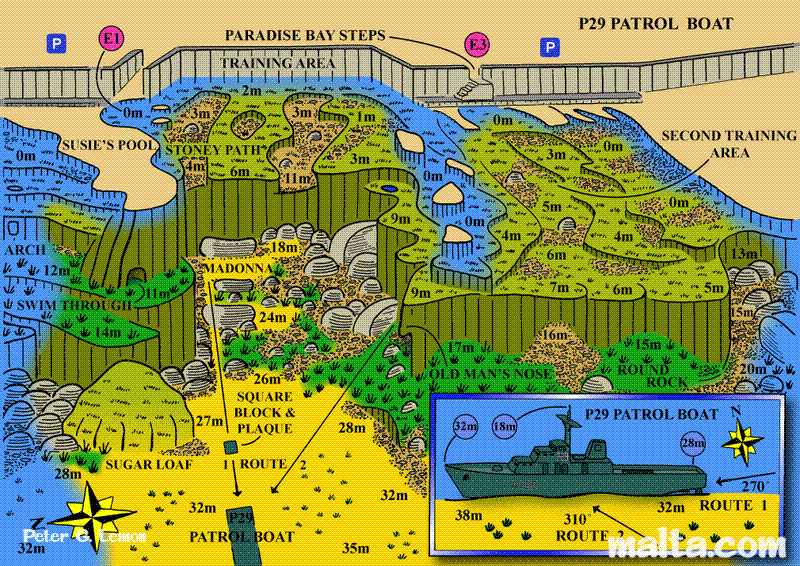
The image below shows the underwater terrain about the wreck. According to the sketch, we used "route 1", which is probably the shortest and easiest to get to the wreck (from Malta.com)


Schematic

Dive Report

Entering at Susie's pool, Rob and I switched onto our stage which for me contained around 110 bar of 50%. From there we swam out at 10m, staying behind and above Steve who is guiding us to the wreck. With Steve at 25-30m, the bubbles of his exhale created a beautiful curtain that stretched right up from the depths to the surface above us.

Curtain of bubbles from Steve
Once the wreck becomes visible, I indicate to Rob that we should switch on to back gas (as breathing 50% at 30m+ when on the wreck would expose us to extremely high levels of oxygen, whereas we've got trimix in the twinset on our back with far less oxygen (about 25% vs. 50%), both switched and comfortable, we then descended onto the wreck. Congregating at the stern, we made sure the team was settled (now consisting of Chris Ryan, Rob and I), before setting off to swim along the port side.

In the number 1 position, I swam forward (there were many doors and windows at the rear of the superstructure, but we wanted to swim forward first), as I swam forward I gently ascended up the side of the super structure to be level with the bridge, most of the instruments were removed here, but the console and windows were still in place. The massive amount of fish swimming around the wreck is beautiful! The wreck is also covered in plantlife which is thriving.

Schools of fish on the wreck
Stopping at the top of the superstructure, I look back and I can see the light from Rob is stable so I continue onwards to the bow, descending as I go, just in front of the super structure is the gun. This gun has been placed as the patrol boat isn't normally equipped with a gun like this, regardless it still makes for a great photo opportunity! Just in front of the gun, I see an open hatch leading down into the bow - if only I had a full twinset then I'd feel like I could explore more!

I swam along the gun then circled around to head along the starboard side. I had got to the entry door when I looked behind me to see that Rob and Chris were not behind me, they were still at the gun taking pictures.

Rob at the gun
With the team re-assembled, we entered the hatch on the starboard side. Turning right and then descending into the next room (there were actually holes cut into the floor of the compartment that we just entered, but they looked a little cosy to swim through and my team is still coming through the hatch above me and might not see me descending again).

The first compartment
In this room, I turned left to head towards the stern, this next room in particular still has gauges mounted on the wall, some kind of instrumentation room. I did a quick 180 to check on the guys behind me, I see two torches, neither moving rapidly so all is well. Continuing on I suddenly have a dawning realistion: I'm doing the exact same route as I did two years ago, but this time I have trimix in my twinset which is making everything clearer - this journey through the ship certainly feels longer than last time. Leaving the room with the gauges, there is a very short corridor which leads further aft and ultimately exits into a compartment that is a largish cargo hold at the stern. 

Gauges
Once in this cargo hold, I waited so that I could see the entire team in this compartment. This compartment felt very different from what I remembered of my previous dive - again proves how valuable the trimix I'm breathing is - even at 34m things are exceptionally different from how I remember! Chris was following close behind and took a picture of Rob as he swam through.

Cargo room
I ascended up what appeared to be an elevator shaft into the outside world. Chris followed me with Rob ascending third. I think that I was stressed because I felt like my breathing was elevated for the entire dive, so I took a few moments to rest on this ledge while Chris took pictures of Rob coming up.
Ascending up
At this point I was down to about 80 bar so thumbed the dive on gas reserves, minimum gas had been set at 60 bar so I didn't think with my current state there was any point exploring anywhere safely as I would quickly burn through that last 20 bar and then into our safety reserves.

Getting ready to leave the wreck, I remembered that we arrived from the back-right corner of the ship, when I pointed in that direction (supported by my compass) Chris disagreed with me and pointed straight off the stern ... He's been here several times so clearly knows more than I do.
Swimming along we passed above the anchor so I knew we were on the right way back even though it didn't seem right by my bearings.

The anchor
Rob and I then did a switch onto our stages with 50% in at 21m on the fly (but still a team switch).
We swam back to Cirkewwa, looked in on the Madonna statute located in an alcove just below Susie's pool before finally ascending up into Susie pool where Chris took a picture of us he then found a fish very similar to the lethal stone fish.

Madonna statue
After completing deco we exited and came home to Techwise where we met Julie.

Video

During the dive I was carrying a GoPro Hero (the photos above are simply stills from the video), I have assembled a small video about our dive which is below.


P29 from Chris Armstrong on Vimeo.